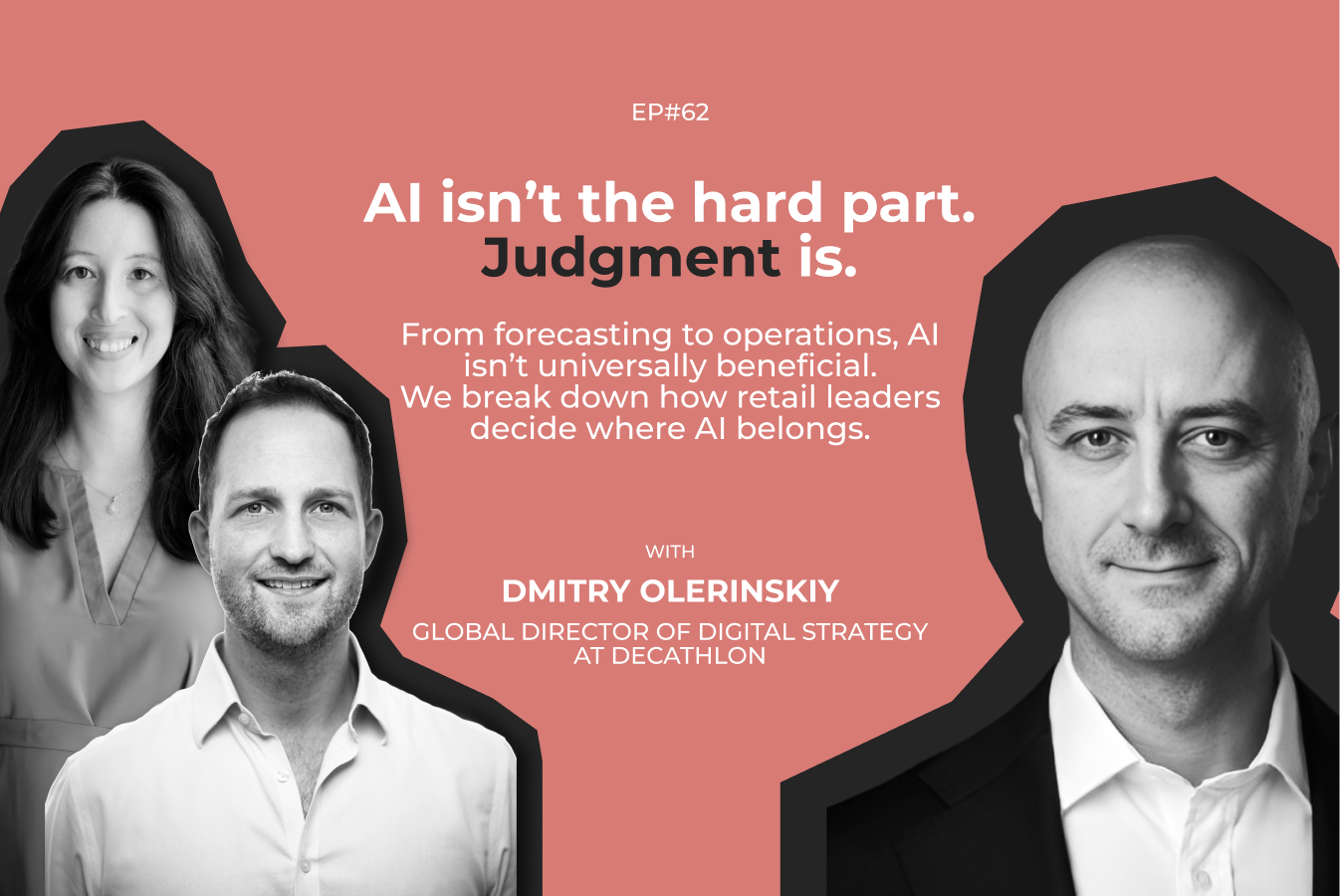
#62 AI Decisions at Scale: What Works and What Doesn’t, with Dmitry Olerinskiy from Decathlon
Links: Google - Pocket Cast - Anchor - Spotify - Apple
Artificial intelligence is everywhere in retail right now. From demand forecasting and content creation to customer service and supply chain optimization, AI is often presented as the next inevitable step in digital transformation. The promise is speed, efficiency, and intelligence at scale.
But scale is exactly where things get complicated.
In a recent conversation with Dmitry Olerinskiy, Digital Strategy Director at Decathlon, one theme stood out clearly: AI itself is not the hard part. Judgment is. Knowing where to apply AI, where not to, and who remains accountable when things go wrong has become one of the most critical leadership challenges in modern retail.
Digital Transformation Is Not a Single Thing
The term digital transformation in retail has been used for more than a decade, often as a catch-all phrase. In practice, it means very different things depending on context, geography, and maturity.
In some markets, digital transformation has been closely associated with IT infrastructure and hardware. In others, it has focused on customer touchpoints, e-commerce, and omnichannel retail. In vertically integrated retailers like Decathlon, it extends even further upstream into product design, production, and supply chain digitization.
The common thread is not technology for its own sake, but industrialization through digital platforms. Customer experience improvements, such as seamless omnichannel journeys, are only possible because of deep changes in data foundations, business processes, and operational systems.
This is important because AI is often positioned as the next transformation layer. In reality, AI builds on top of these foundations and amplifies both their strengths and their weaknesses.
AI Is Not Universally Beneficial
One of the most persistent myths in AI transformation is that more intelligence automatically leads to better outcomes. In retail operations, this is often not the case.
Many core retail processes require precision, determinism, and predictability. Examples include:
inventory allocation
demand forecasting
pricing rules and replenishment logic
order status and customer service queries
In these areas, traditional algorithms, econometric models, or regression-based approaches often outperform generative AI. They are easier to test, easier to explain, and easier to govern.
Generative AI, by contrast, is probabilistic by nature. It is designed to generate plausible outputs, not guaranteed correct ones. That makes it powerful for exploration, pattern discovery, and creative work, but risky for deterministic decision-making.
A key takeaway for retail leaders is this: not every retail problem needs AI. Some problems need better data quality, clearer rules, or more robust algorithms, not more intelligence.
Helpful AI vs Harmful AI
The real leadership challenge is distinguishing between helpful AI and harmful AI.
Helpful AI tends to appear in contexts where:
the problem space is not fully defined
human judgment remains firmly in the loop
the goal is exploration rather than execution
unknown patterns or weak signals need to be surfaced
This is where AI can act as a powerful co-pilot. It can analyze large volumes of data, surface unexpected correlations, and provide new perspectives that humans may not have considered.
Harmful AI emerges when:
outputs are exposed directly to customers
errors scale instantly across systems
accuracy is non-negotiable
accountability is unclear
At enterprise scale, even small errors can propagate quickly and visibly. What might be acceptable experimentation in a startup can turn into reputational, financial, or legal risk for a global retailer.
This is why AI adoption strategy for enterprise retailers looks fundamentally different from AI experimentation in early-stage companies.
Why Scale Changes Everything
Scale introduces a different risk profile. Large retailers operate across countries, channels, and customer segments. Decisions made by AI systems can affect millions of customers simultaneously.
At this level, speed is no longer the primary advantage. Trust is.
Sandbox environments become more important than rapid deployment. Testing AI use cases quietly, validating assumptions, and stress-testing edge cases are not signs of conservatism, but of maturity.
At scale, experimentation without guardrails becomes liability.
This applies not only to customer-facing systems such as chatbots, but also to internal tools like demand forecasting, marketplace analytics, and seller insights platforms. AI governance frameworks for retailers are no longer optional. They are a prerequisite for sustainable AI adoption.
Accountability Never Shifts to Machines
Another recurring misconception is that AI reduces human responsibility. In practice, the opposite is true.
AI does not sign contracts.
AI does not face customers.
AI does not carry brand risk.
Humans choose the systems.
Humans approve the outputs.
Humans remain accountable for the consequences.
This is why AI literacy for business leaders must go far beyond basic usage. Leaders need to understand where AI outputs stop making sense, how bias enters models, and why explainability matters. This requires both subject-matter expertise and critical thinking.
Treating AI like a junior colleague is a useful mental model. It can work fast, surface ideas, and assist with analysis, but its outputs always require review, context, and responsibility from more experienced decision makers.
Precision vs Creativity in Retail Operations
One of the most practical distinctions to emerge is the difference between creative and operational use cases.
Creative and exploratory work benefits from AI’s ability to generate imperfect but stimulating outputs. Hallucinations, while dangerous in factual contexts, can sometimes spark new thinking when used deliberately and responsibly.
Operational retail processes, however, require stability. In these contexts:
precision beats creativity
reliability beats novelty
governance beats speed
Understanding this distinction helps retail leaders decide where generative AI belongs and where it should stay out of the critical path.
The Leadership Skill That Matters Most
As AI becomes cheaper, faster, and more accessible, the competitive advantage shifts away from access to technology and toward judgment.
The most underrated leadership skill in the age of AI is not technical expertise. It is restraint.
Knowing when to say yes to AI.
Knowing when to say no.
Knowing what must remain human.
Retail transformation has never been about technology alone. It has always been about choices. AI simply makes those choices more consequential.
For a deeper, experience-based discussion on AI decisions at scale, this conversation with Dmitry Olerinskiy offers valuable perspective. You can listen to the full episode of The Retail Reality Show on Spotify or Apple Podcasts.