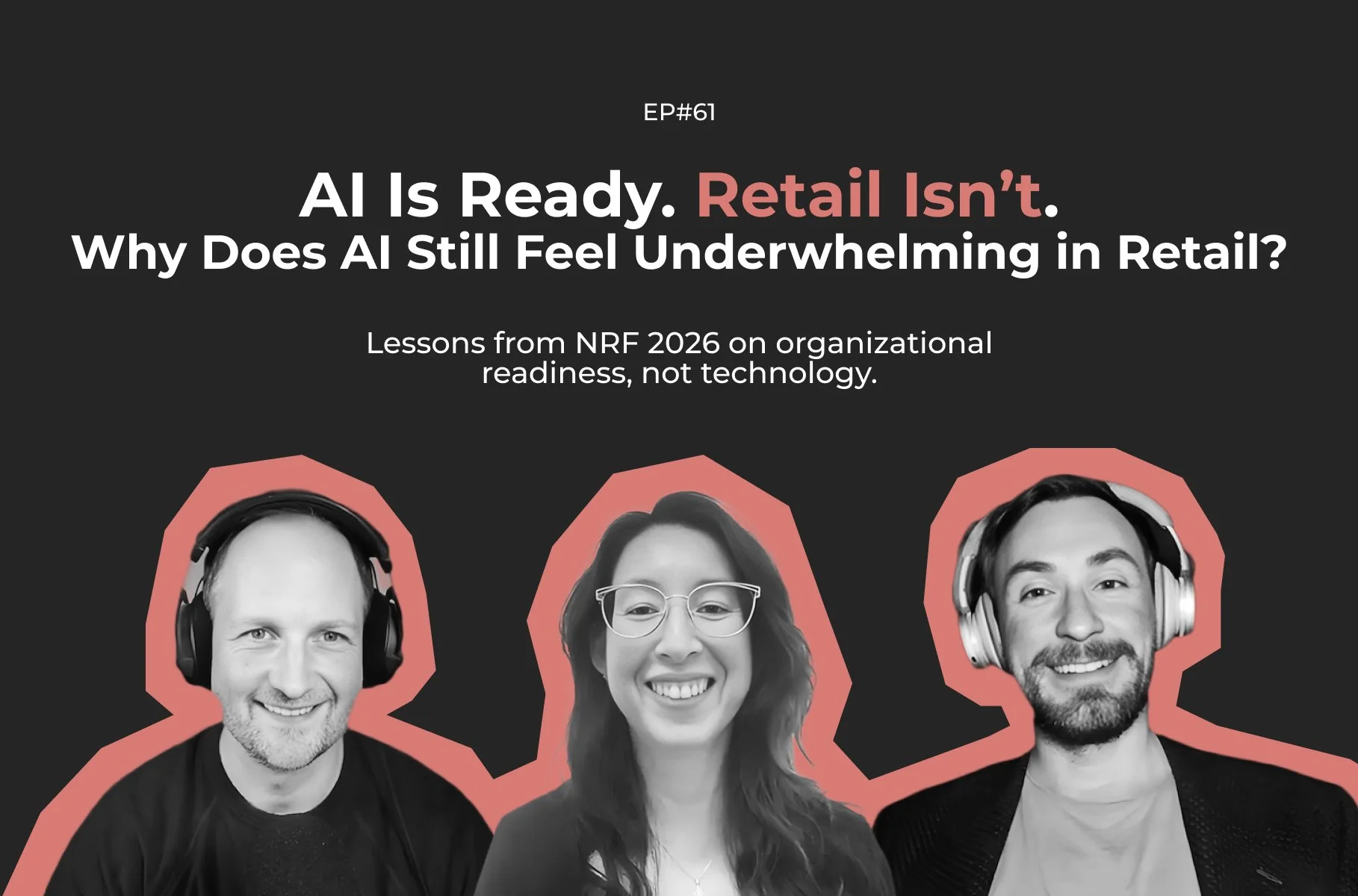
#61 AI Is Ready, Retail Isn’t – Lessons from NRF 2026
Links: Google - Pocket Cast - Anchor - Spotify - Apple
The conversations at NRF 2026 made one thing unmistakably clear:
Artificial Intelligence in retail is no longer the limiting factor.
The tools are mature.
The platforms are powerful.
The use cases are visible across customer service, merchandising, supply chain, and search.
And yet, many retailers still describe their AI initiatives as underwhelming.
This tension was the starting point for the latest episode of The Retail Reality Show, recorded after NRF 2026. But more importantly, it reflects a broader industry reality that goes far beyond one event.
AI in Retail Has Entered a New Phase
For several years, AI in retail was defined by experimentation.
Retail leaders asked foundational questions:
What is AI? Where does it apply? Is it even relevant?
That phase is over.
At NRF 2026, the conversation had clearly shifted. Retailers are no longer asking whether to use AI, but how to make it work at scale. Across the show floor and side events, most organizations were already implementing AI in some form, whether through conversational search, automated customer service, demand forecasting, or personalization engines.
This marks an important step in AI maturity in retail. But maturity in tools does not automatically translate into maturity in organizations.
Why AI Still Feels Underwhelming
Despite widespread adoption, many AI initiatives fail to deliver meaningful impact. This is often misdiagnosed as a technology problem.
In reality, the more common issue lies elsewhere.
Most retailers are using AI to augment existing processes rather than rethinking them. AI is added on top of workflows that were designed for a pre-AI world. KPIs remain unchanged. Organizational structures stay intact. Decision rights are unclear.
The result is predictable:
More efficiency, but little transformation.
This pattern explains why so many AI projects in retail stall after the pilot phase. The technology performs as expected, but the organization does not change enough to unlock its full potential.
The Augmentation Trap
Augmentation is not inherently wrong. Automating repetitive tasks or speeding up existing workflows can generate real value, especially in areas like customer service or operations.
The problem arises when augmentation becomes the ceiling rather than the starting point.
When AI is only allowed to optimize what already exists, it cannot fundamentally change how value is created. Retailers end up accelerating yesterday’s logic instead of enabling tomorrow’s possibilities.
This dynamic was visible across many NRF 2026 discussions. Organizations talked confidently about AI tools, yet hesitated when it came to reimagining processes, roles, and responsibilities.
The limiting factor was not imagination in the abstract, but organizational courage.
Agentic Commerce and the Reality Check
Agentic commerce was one of the more visible topics at NRF 2026. The idea of AI agents autonomously searching, selecting, and purchasing products promises a more seamless customer journey.
However, the discussions revealed a more nuanced reality.
Agentic commerce makes sense in highly functional, low-emotion categories such as replenishment or commodity goods. It is far less compelling in inspirational categories like fashion, where discovery, context, and emotion still play a central role.
This reinforces a broader insight:
Not every AI capability represents a universal leap forward. Retail AI use cases must be evaluated through the lens of category, customer intent, and experience design, not hype.
The Interface Shift Is Real
While agentic commerce sparked debate, another shift felt far more certain: the evolution of interfaces.
Search in retail is moving away from keywords toward intent. Customers increasingly express needs in natural language, describing situations, preferences, and context rather than product names. Conversational search, visual search, and voice interfaces are becoming more common.
This does not fundamentally change what retailers need to do, but it changes how customers interact with retail systems.
Retailers need richer product data, clearer context, and better orchestration across channels. The AI layer becomes increasingly invisible, while the experience becomes more fluid.
Physical Retail Moves in the Opposite Direction
Interestingly, the rise of invisible AI coincides with a renewed emphasis on physical retail experiences.
Store tours in New York highlighted environments that were deliberately low-tech and highly human. Hospitality, atmosphere, and emotion played a central role. These concepts are not universally scalable, nor should they be copied blindly.
But they serve as inspiration.
Retail is not choosing between automation and experience. It is being shaped by both at the same time. The challenge is connecting invisible AI orchestration with tangible, human-centered experiences in a way that feels coherent.
Organizational Readiness Is the Real Bottleneck
Across all these themes, one conclusion stands out: organizational readiness determines AI success more than any technical limitation.
Common signs that organizations are not ready include:
Unclear success metrics
Waiting for “perfect” solutions
AI projects with overly broad scopes
Education being delegated rather than embedded
These patterns slow progress far more than data quality or model performance.
AI readiness does not start with a roadmap. It starts with clarity.
Clarity about which decisions can change.
Clarity about which processes are no longer sacred.
Clarity about what people need to unlearn.
Without that, even the best AI technology will continue to feel disappointing.
Looking Ahead
NRF 2026 did not signal a slowdown in AI adoption. On the contrary, it showed that AI in retail is accelerating rapidly.
But the next phase will not be won by those with the most tools. It will be won by those willing to rethink how retail organizations operate in an AI-native world.
The full conversation exploring these dynamics can be found in our episode #61 AI Is Ready, Retail Isn’t – Lessons from NRF 2026 of The Retail Reality Show.