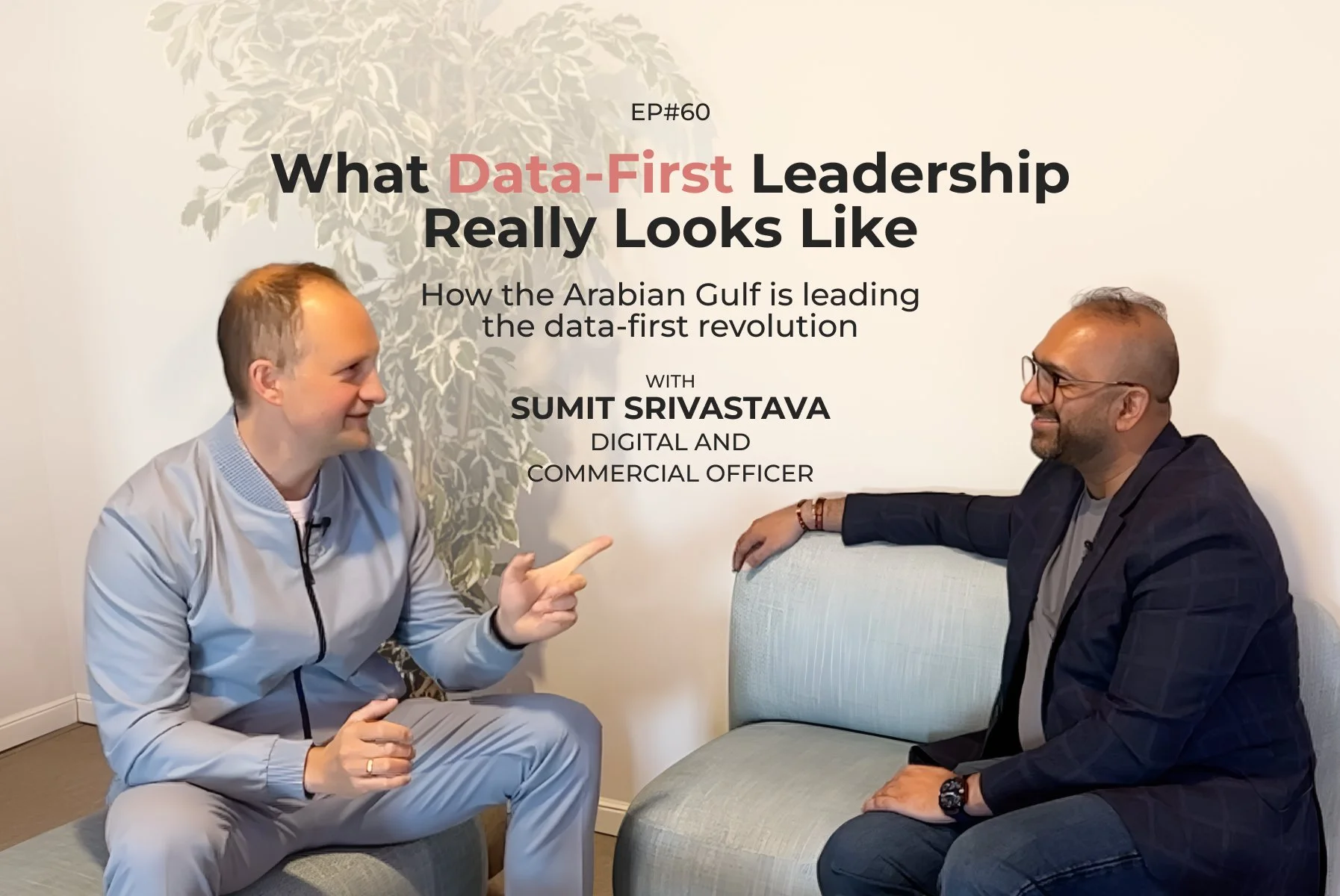
#60 Data-First Leadership in Action: Sumit Srivastava on Connecting AI, Data & Customer Experience
Links: Google - Pocket Cast - Anchor - Spotify - Apple
What Data-First Leadership Looks Like: Inside the Omnichannel Revolution
Retail in the Gulf Cooperation Council (GCC) is changing faster than almost anywhere else in the world.
Once labeled an emerging market, the Arabian Gulf has become a living laboratory for how AI, data, and customer experience converge to define the next era of omnichannel retail.
In Episode #60 of The Retail Reality Show, Sumit Srivastava, Digital and Commercial Officer, joins host Nino Bergfeld to discuss what data-first leadership really means and why the region’s retailers are not just keeping up but leapfrogging traditional markets.
From emerging market to global benchmark
For decades, retail growth in the Gulf followed Western blueprints.
Today, that script has flipped. Massive investment in cloud infrastructure, AI capabilities, and digital talent is turning the GCC into a new innovation hub. Governments across the United Arab Emirates, Saudi Arabia, Qatar, Kuwait, Bahrain, and Oman are building digital economies at record speed, while local conglomerates operate complex, data-rich retail ecosystems that span fashion, beauty, automotive, and luxury.
Srivastava calls this transition “a mindset shift from importing innovation to exporting it.”
The region is no longer testing what works elsewhere; it’s building the playbook others will follow.
App-first consumers and real-time commerce
One of the clearest signs of this transformation is the rise of native app commerce.
In the GCC, 70-90 percent of retail transactions already happen inside branded mobile apps. High smartphone penetration, young demographics, and frictionless digital payment rails have made the app experience the default shopping channel.
That shift forces retailers to think beyond “online vs. offline.” Instead, the focus is on real-time journeys where data from stores, websites, and apps flows continuously through one connected architecture.
According to Sumit Srivastava, this ecosystem links POS, CRM, e-commerce, and clickstream data, updated every few minutes, to power dynamic recommendations, personalized offers, and agile inventory decisions.
The result is predictive retail:
knowing what customers want before they start searching.
AI that runs the business
In many global markets, artificial intelligence in retail still sits in the marketing department.
In leading corporations, AI already touches the entire value chain, from demand forecasting and logistics optimization to personalized product recommendations and assortment planning.
Srivastava explains that the goal is not to automate creativity but to make better, faster decisions: “AI helps us move from reaction to prediction. It’s not just about content; it’s about context.”
By analyzing how and when customers interact with each brand, predictive models can anticipate needs, trigger back-in-stock alerts, or even pre-build shopping carts ready for a quick yes/no confirmation.
This is data-driven omnichannel retail in action, where machine learning supports human intuition instead of replacing it.
The architecture behind a data-first strategy
To make this work, the company built a data lakehouse architecture that merges structured and unstructured data: POS transactions, loyalty activity, web behavior, social interactions, and conversational commerce.
A near-real-time orchestration layer routes new data every few minutes, classifying it by engagement type and pushing insights directly into CRM and marketing platforms.
This continuous feedback loop enables the brand to act within minutes – not days – after a purchase.
Buy a jacket in store, and within five minutes you might receive a curated “shop-the-look” suggestion built on market-basket correlations from thousands of similar transactions.
It’s the infrastructure of data-first leadership: an organization that treats information as a living asset, not a reporting afterthought.
Why leadership, not technology, is the differentiator
Srivastava is quick to point out that technology alone doesn’t guarantee transformation.
Many retailers fail, he says, because they underestimate the complexity of data and delegate it too far down the hierarchy.
True change happens only when leaders understand that data is the operating system of the entire business. That requires education, empowerment, and cross-functional governance.
Roles like Chief Data Officer or Chief Technology Officer need both autonomy and accountability: build, clean, and connect the data and show measurable value fast.
Small, frequent wins prove the model and keep momentum alive.
As Srivastava puts it:
“Being data-first isn’t a tech decision. It’s leadership.”
From SEO to GEO: Preparing for Generative Search
Another emerging topic in the conversation is Generative Engine Optimization (GEO), the next evolution beyond SEO.
As LLMs and AI agents increasingly act as shopping assistants, retailers must ensure their websites are readable for machines as well as humans. That means clear markup, accessible APIs, and structured content that intelligent agents can interpret, reason over, and transact with.
In a region already fluent in experimentation, the GCC is likely to become one of the first to operationalize GEO at scale, transforming how consumers discover and buy products through conversational search.
A region that leads by example
The episode closes on a powerful note: the Gulf’s retail transformation isn’t about size or capital alone. It’s about speed, integration, and mindset.
By uniting AI, data, and customer experience, Sumit Srivastava outlines what a truly modern retail organization looks like:
Omnichannel as a continuous journey, not a department
Leadership driven by evidence, not assumption
Willingness to reinvent faster than the market demands
For global retailers watching the region, the takeaway is clear:
The future of retail won’t be built where it started.
It will be built where data leads first.