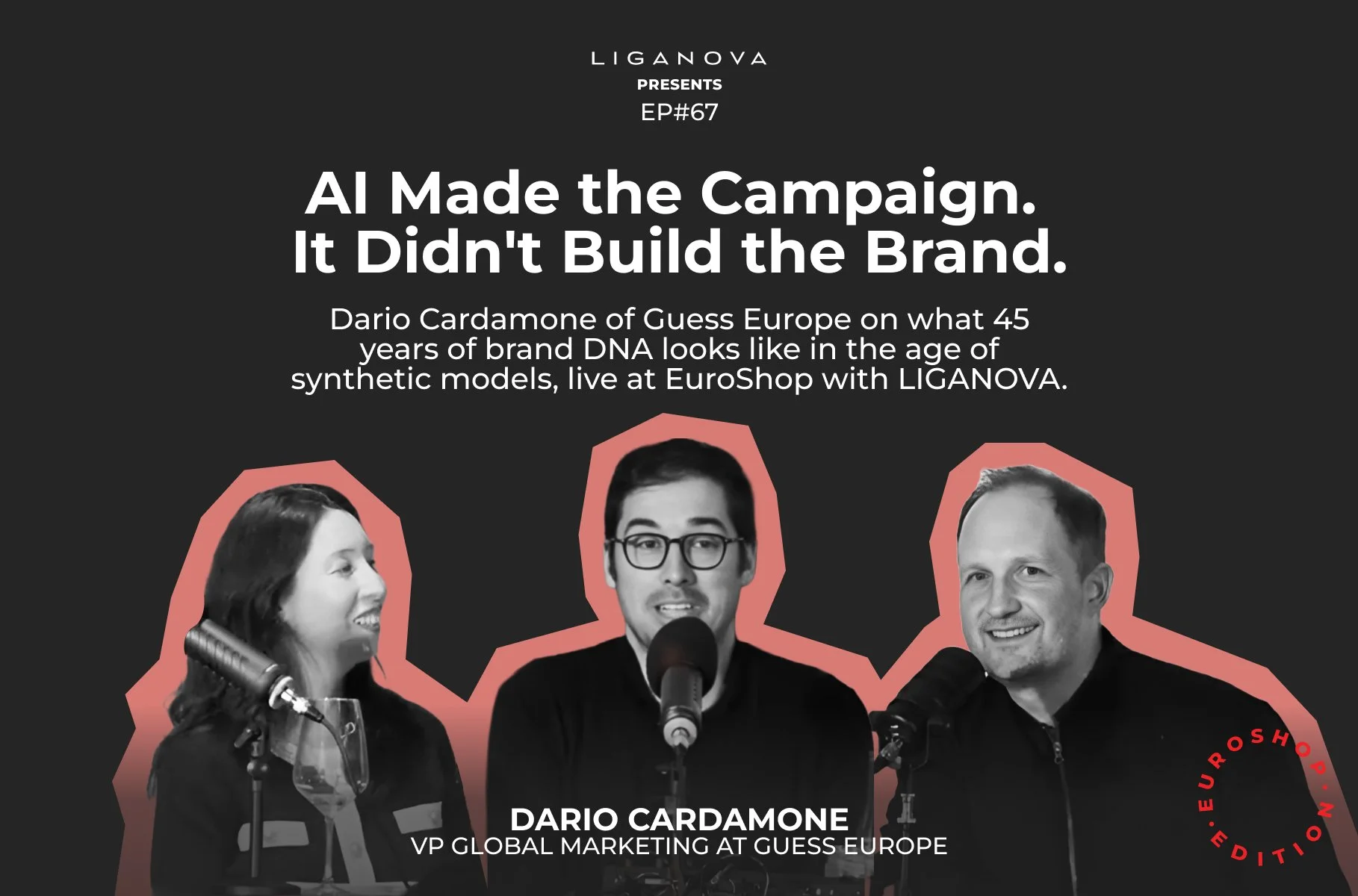
#67 AI Made The Campaign: But Who Builds The Brand? With Dario Cardamone of Guess Europe
Links: Google - Pocket Cast - Anchor - Spotify - Apple
Guess ran one of the most talked-about AI campaigns in fashion history. Then their VP of Global Marketing said they might not do it again. That tension is exactly where the most important conversation in marketing lives right now.
In 2025, Guess placed a fully AI-generated model in American Vogue. No location scout. No casting director. No flight to Capri. Just a synthetic image and the highest earned media value the brand had seen in a decade.
The CFO was happy. The press was loud. The internet had opinions.
And Dario Cardamone, the architect of that campaign and VP of Global Marketing at Guess Europe, looked at all of it and said something that most marketing leaders wouldn't have the honesty to admit: maybe they won't do it again. Because he understood something that the metrics alone couldn't tell him.
The Campaign Is Not The Brand
In the same year Guess published that AI model in Vogue, they also staged a live fashion show on a bridge at 3,000 meters altitude with real models, real guests and real mountain air. It was broadcasted live from Glacier 3000, with all the operational complexity that entails.
They ran two vastly different campaigns under one brand. And the contrast between them was not accidental.
One was an experiment in what AI could produce. The other was a statement about what Guess actually is. And the reason both were possible in the same year, without contradiction, is that the brand underneath them was strong enough to hold the tension.
There is a version of the AI marketing story that is simple and seductive: faster content, lower costs, global scale, no model fees. Generative AI in fashion marketing has made that version real. Brands across the industry are using AI-generated imagery to produce campaign assets in days rather than weeks, scaling creative output across markets, channels, and formats at a pace that would have been operationally impossible three years ago.
But efficiency is not identity.
Guess was founded 45 years ago. Its aesthetic was built through real decisions, real people, real images. And with a founder still in the building, this kind of long-term brand building led to a strong DNA that predates LLMs by decades.
When Guess ran its AI campaign, the brand held. The experiment worked precisely because there was something solid underneath it: a 45-year foundation that gave the synthetic image context, contrast, and a story. The campaign felt bold because Guess already meant something.
AI didn't build that. And AI cannot rebuild it if it erodes.
First Mover Advantage Is Real And Temporary
The Guess AI campaign succeeded in part because it was unexpected. Fashion brands in 2024 were not putting fully synthetic models in Vogue spreads. The disruption itself generated the attention, the press pickup, and the earned media spike.
That card can only be played once.
Within a few years, AI-generated campaigns will be the default mode for mid-market and premium fashion brands. Synthetic models will be scalable, affordable, and visually indistinguishable from their human counterparts and the novelty will be gone.
When that point is reached, something interesting will happen:
Real models will become a luxury signal.
This is not a new pattern. Think about vinyl, handmade products, or farm-to-table food. The mass-produced version scales and commoditizes. The human version becomes scarce, and scarcity becomes value. The brands that remained human at the center of their campaigns will own that positioning. Not because they couldn't afford AI, but because they understood what they were communicating and chose accordingly.
Guess saw this coming. Alongside the AI campaign, they also launched Guess Elite, their loyalty program, doubling down on direct human relationships with their most valuable customers at exactly the moment everyone else was chasing synthetic scale. In an era when most brand conversations are about automation and reach, investing in CRM and personal connection is a quietly countercultural move. It signals that the brand understands the difference between the campaign and the relationship.
The question for every brand strategy team right now is not whether to use AI-generated content. It is what you should be protecting when you do.
The Quiet Disruption: AI Search and Brand Visibility
The AI-generated campaign debate is loud. The shift happening in search is quieter and arguably more consequential for long-term brand strategy.
Generative Engine Optimization, or GEO, is emerging as the successor to traditional SEO. When consumers turn to ChatGPT, Perplexity, or similar platforms to research a brand, a product, or a category, the rules of visibility change entirely. Your visual identity doesn't travel. Your brand guidelines don't help. What reaches the model, and through it the consumer, is your words, your reputation, and how clearly and honestly you have defined your brand.
A brand built on feeling and aesthetics has to learn to be legible to a machine.
The brands appearing in AI-generated search results are not necessarily the best in their category. They are the most clearly defined. They have answered the questions that consumers are actually asking in the structure that large language models process most naturally: a question followed by an honest, specific answer.
For fashion and retail brands investing in content strategy, this means the era of vague aspirational copy is quietly ending. Specificity, authenticity, and structured clarity are becoming ranking signals in a new kind of search, one that is already changing where consumers discover brands, and which brands they trust when they get there. The brands that get this right now, before the space becomes as saturated and commercial as Google, will hold a significant and durable discoverability advantage.
Is Agentic AI Ready for Marketing?
The AI conversation in marketing tends to collapse into a single question: are you using it yet? The more useful question is: where?
Agentic AI refers to systems that operate autonomously toward a defined goal, without a human approving each step. These systems are already capable of running significant parts of a modern marketing operation. Performance campaign management, content production at scale, CRM personalization, and data verification are all areas where autonomous AI delivers speed and consistency that human-led processes cannot match.
But there are clear boundaries, and the most costly mistakes happen when brands ignore them.
New product launches require cultural intuition. Brand positioning decisions require an understanding of values that no prompt can fully encode. Anything touching the emotional contract between a brand and its customers requires a human being in the loop to protect the brand and the human and emotional side of it.
The marketing leaders navigating this well are not asking whether to trust AI. They are building a clear internal map of where autonomy is an asset, where human judgment is non-negotiable, and where the line between the two needs to move as the technology develops.
What the CMO of 2026 Actually Looks Like
The marketing leadership role is being rebuilt in real time.Today's CMO is expected to protect the brand's long-term identity while simultaneously deploying technology that changes every few months. They advise founders on strategic decisions with cultural dimensions that no dashboard captures. They translate data into creative direction and creative instinct into measurable outcomes. These are not separate skillsets that can be divided across a team. They have to live in one person, or at least one leadership function, with enough coherence to make fast, consistent decisions.
Underneath all of it, one capability matters more than any tool proficiency: human connection.
It is no longer a soft skill but it has become a structural competitive advantage.
AI is systematically absorbing the tasks that can be defined, repeated, and optimized. What remains is the capacity to understand people and to know why a campaign feels right even when the data says otherwise. The job now includes protecting the emotional core of a brand when everything around it is moving fast.
The next generation of marketers will grow up native to AI tools in a way that gives them a genuine advantage. The ones who build lasting careers will be the ones who also protected something else: the ability to be irreplaceably human in a world that can generate everything except that.
Guess's AI campaign was a bold move and the results were outstanding. But in the end, the story worth carrying forward is not the campaign. It is the 45 years underneath it, and the deliberate choices that kept the brand intact while the experiment ran.