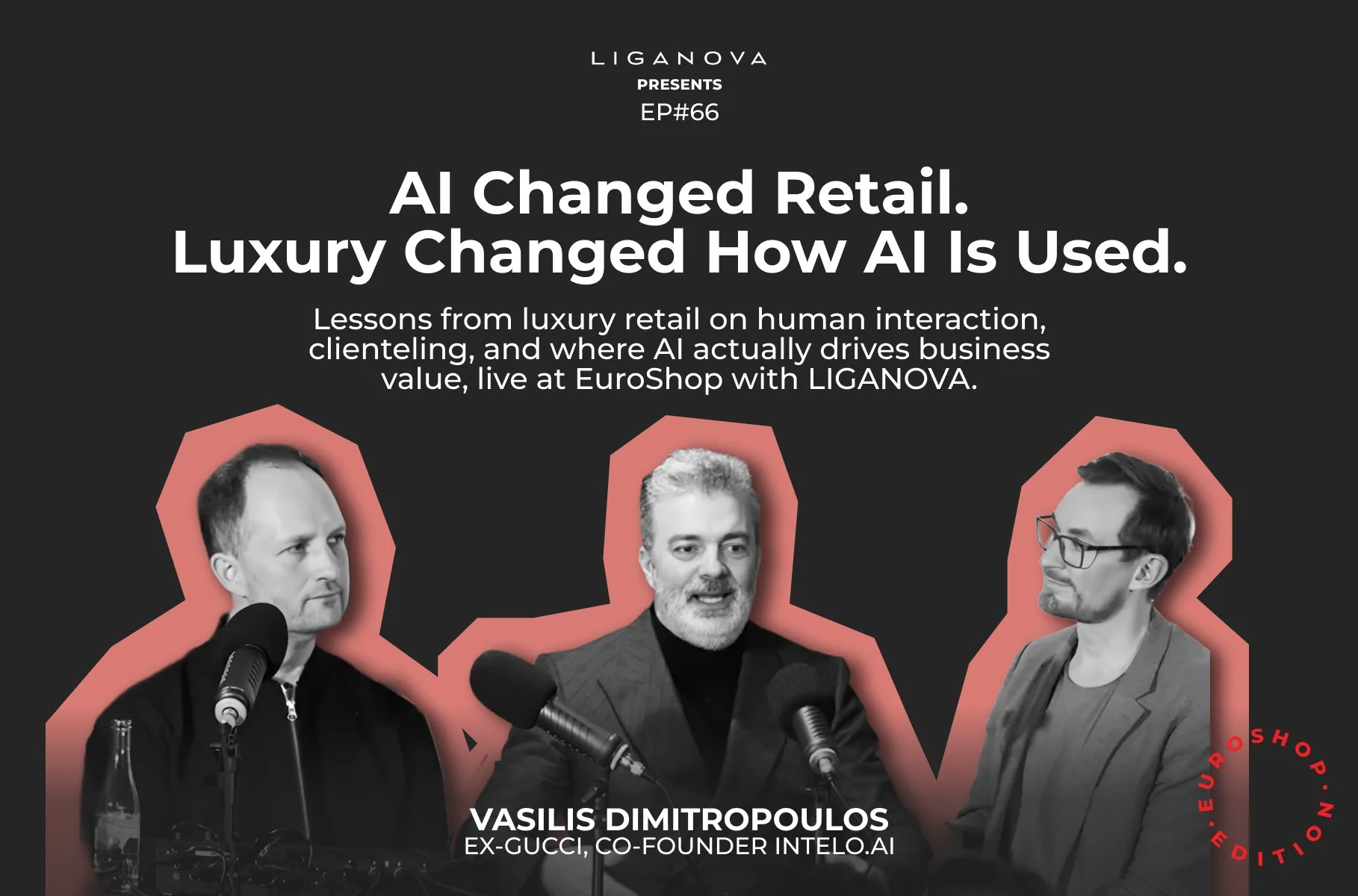
#66 High-Touch, High-Tech: The New Luxury Playbook with Vasilis Dimitropoulos of Intelo.ai
Links: Google - Pocket Cast - Anchor - Spotify - Apple
What happens when luxury retail meets artificial intelligence?
In a recent conversation at our live event with LIGANOVA at EuroShop in Düsseldorf with Vasilis Dimitropoulos, former Gucci leader and now Co-Founder of Intelo.ai, one thing became clear: the future of retail is not about choosing between humans and technology. It is about orchestrating both.
This shift is already redefining how leading brands approach customer experience, clienteling, and even core operations like merchandising and planning.
Why Luxury Took a Different Path in AI
While much of the retail industry rushed to automate customer interactions, luxury brands followed a fundamentally different strategy. Instead of asking how to reduce human involvement, they asked a more critical question:
How can technology enhance human interaction?
This distinction is subtle, but decisive.
In many retail environments, the introduction of AI led to chatbots, scripted responses, and standardized communication. The goal was efficiency. The outcome, however, was often a loss of emotional depth and differentiation.
Luxury retail operates under different conditions. Here, customer experience is not just a function. It is the product. That is why leading luxury brands avoided replacing human advisors with automation. Instead, they focused on AI-assisted clienteling, where technology works in the background to support more meaningful, more personalized interactions.
This approach aligns with a broader shift toward human-centered AI in retail, where emotional intelligence, taste, and judgment remain core differentiators.
From Customer Service to Revenue Driver: The Gucci 9 Model
One of the most compelling examples of this transformation is Gucci 9. Rather than treating client services as a traditional support function, Gucci reimagined it as a remote clienteling luxury retail model.
Customers could connect directly with trained advisors via chat or video, receive curated product recommendations, and complete purchases within the same interaction. The experience was designed to mirror the in-store environment, extending the brand’s identity into the digital space.
This was not incremental optimization. It was a structural shift.
Client services evolved from a cost center into a measurable contributor to revenue. Interactions were no longer isolated events but part of a broader luxury omnichannel experience strategy, where every touchpoint could influence purchasing behavior. Critically, this model relied on technology without becoming technology-driven.
AI was used to support advisors, for example in tone of voice, product knowledge, and recommendation logic. But the human remained in control of the interaction.
This is a key principle for AI in high-touch retail environments:
Technology enhances capability. It does not replace judgment.
The Measurable Impact of AI-Assisted Clienteling
One of the most overlooked aspects of AI in retail is measurement. Many initiatives struggle because they cannot clearly demonstrate business impact. Gucci approached this differently. Interactions were tracked beyond the moment they occurred. The question was not only whether a customer engaged, but what happened afterward.
→ Did the customer purchase within the following days or weeks?
→ Did the interaction influence in-store or online behavior?
This allowed the team to connect clienteling activities directly to revenue outcomes.
Even early experiments with conversational AI in luxury retail showed measurable effects. When AI-supported language was used to assist advisors during live interactions, conversion rates increased. The uplift was modest, but significant at scale.
This highlights an important principle in AI-driven customer experience retail: Small improvements in interaction quality can translate into substantial commercial impact when applied across thousands of touchpoints.
Where AI in Retail Actually Creates Value
For years, the conversation around AI in retail strategy has focused heavily on marketing and customer-facing applications. However, many of these use cases have struggled to scale or deliver consistent return on investment. A growing body of evidence suggests that the real value of AI lies elsewhere. In operations.
Specifically in areas such as:
– AI merchandising optimization
– Retail assortment planning AI
– AI-driven demand forecasting
– Retail inventory and allocation decisions
These domains share a common characteristic: they are structured, data-rich, and highly consequential for business performance.This is where agentic AI retail applications are beginning to reshape decision-making. Instead of simply supporting conversations, AI is now supporting decisions.
From Black Box to Open Box: The Adoption Challenge
One of the key barriers to AI adoption in retail companies is trust. Many systems operate as “black boxes,” providing recommendations without explaining how they were generated. This limits adoption, particularly in areas like merchandising where expertise and accountability are critical.
A more effective approach is what can be described as “open-box AI.” In this model, users can understand, challenge, and interact with the system’s logic. The interface becomes conversational, allowing planners and decision-makers to engage with AI in a more intuitive way.
This has two major advantages: First, it increases trust and usability. Second, it enables contextual learning, where the system improves through interaction. For AI-powered retail decision making, this shift is essential.
The Real Opportunity: Redesigning Retail Processes
Perhaps the most important insight is not about technology itself, but about how it is applied. Many organizations approach AI as a tool to optimize existing processes. They automate specific steps, reduce manual effort, and improve efficiency. While valuable, this approach is inherently limited. It assumes that the underlying process is already optimal.
The real opportunity lies in AI-driven business process redesign. Instead of asking how AI can improve what already exists, leading companies are asking: How should this process look if it were built around AI from the ground up?
This shift moves organizations from incremental optimization to true transformation. It is the difference between becoming more efficient and becoming fundamentally more effective.
Human and AI: Not a Trade-Off, but a System
The emerging model in retail is not human versus machine. It is a system where both play distinct roles.
– Humans bring creativity, taste, and emotional intelligence
– AI brings scale, precision, and analytical power
This is particularly evident in merchandising, where decisions combine art and science. AI can process vast amounts of data to identify patterns and optimize outcomes. But the final judgment, especially in a luxury context, still requires human intuition.
This hybrid model defines the future of luxury retail innovation.
Conclusion: The New Luxury Playbook
The new luxury playbook is not about adopting AI faster than others. It is about adopting it differently.
– By enhancing human interaction instead of replacing it
– By focusing on measurable impact instead of hype
– By shifting attention from front-end experiences to operational intelligence
– By redesigning processes instead of merely optimizing them
This approach does not only apply to luxury brands. It offers a blueprint for any retailer looking to navigate the next phase of digital transformation.
For those who want to explore these ideas in more depth, the full conversation provides a detailed look at how these principles are being applied in practice.