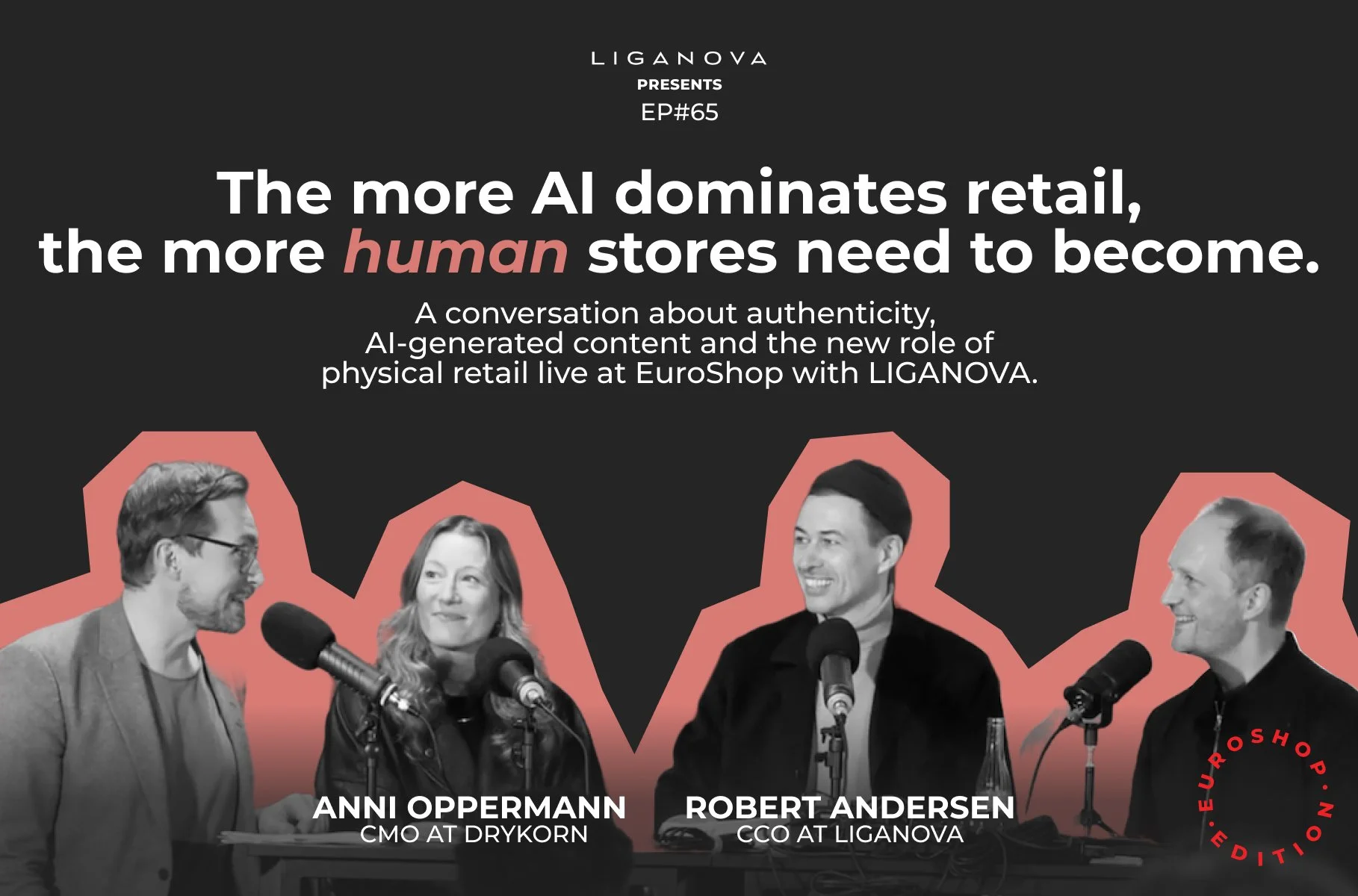
#65 Emotional Intelligence Meets AI: The Store as a Human Anchor with Anni Oppermann (DRYKORN) & Robert Andersen (LIGANOVA)
Links: Google - Pocket Cast - Anchor - Spotify - Apple
Artificial intelligence is rapidly transforming retail. From AI-generated campaigns to hyper-personalized customer journeys, brands now have access to tools that can produce content, analyze behavior, and optimize marketing at unprecedented scale.
But this transformation is creating an unexpected side effect.
The more synthetic and algorithmically generated the digital world becomes, the more valuable real-world retail experiences are.
This tension between technology and human experience sits at the heart of the future of physical retail. In a recent conversation with fashion marketing leader Anni Oppermann (DRYKORN) and creative strategist Robert Andersen (LIGANOVA), we explored how AI in retail, authentic brand experiences, and human connection in stores are reshaping what retail spaces need to be.
The conclusion is surprising:
AI might not replace physical retail.
Instead, it may actually make it more important.
The Rise of Synthetic Retail Experiences
AI is already reshaping how brands communicate with customers. Modern retail marketing increasingly relies on AI-driven personalization, automated content generation, and data-driven merchandising.
Artificial intelligence can now generate:
– Product images
– Social media visuals
– Marketing campaigns
– Entire product descriptions
– Personalized recommendations
These technologies dramatically increase efficiency. They allow retailers to produce content faster, localize campaigns across markets, and create AI-powered retail marketing automation at scale.
But they also introduce a new challenge.
As AI-generated media becomes more common, it becomes harder for consumers to distinguish what is real and what is synthetic.
This growing flood of AI-generated visuals and advertising can lead to what many marketers call a trust problem in digital media. When every brand can generate polished campaigns instantly, differentiation becomes harder. Content starts to look similar. Perfection becomes normalized.
Ironically, this technological advancement creates a new scarcity.
Authenticity.
And that is where physical retail stores enter the picture again.
Why Physical Retail Still Matters in the Digital Age
For years, industry conversations focused on the decline of brick-and-mortar retail. E-commerce growth, digital marketplaces, and online discovery seemed to threaten the relevance of stores.
But the reality of experiential retail strategy suggests a different trajectory.
Physical stores offer something the digital world cannot easily replicate: human presence, sensory experiences, and emotional interaction.
Retail experiences are remembered not just through products, but through feelings.
Customers may forget the exact item they browsed.
But they remember how a store made them feel.
This is why emotional retail experiences and retail store experience design are becoming central to the future of physical retail.
Stores provide:
– Direct interaction with real people
– Spaces where communities can gather
– Sensory experiences that cannot be digitized
– Authentic environments where brands come to life
In an increasingly synthetic digital landscape, the store becomes something more than a sales channel. It becomes a moment of truth for the brand.
The Loneliness Economy and the Social Role of Retail
Another factor strengthening the importance of physical retail is cultural rather than technological.
Despite living in the most digitally connected era in history, research shows that younger generations report increasing levels of loneliness. Gen Z and Millennials are often described as the most connected and yet most isolated generations.
Social platforms provide communication.
But they rarely replace real interaction.
This shift opens a new opportunity for community-driven retail stores.
Physical retail spaces can act as social environments where people interact with strangers, discover new brands together, and experience shared moments.
Some retailers are already experimenting with new ways to encourage this.
One example discussed was a simple but fascinating experiment: shopping carts that signal whether a customer is open to conversation. A specific color indicates that the person is willing to talk or interact with others in the store.
Small ideas like this demonstrate a broader trend: retail spaces can become social infrastructure.
In a world where digital platforms dominate attention, physical environments become the places where real-world connections still happen.
The Authenticity Advantage in an AI-Driven Retail Industry
As AI in retail strategy continues to evolve, one insight becomes increasingly clear:
The brands that succeed will not simply produce more digital content.
They will create more believable experiences.
AI excels at pattern recognition, data analysis, and scalable automation. It can dramatically improve retail merchandising, customer insights, and operational efficiency. But it struggles with unpredictability, emotional nuance, and the imperfect nature of human interaction. This is where the concept of authentic brand experiences becomes powerful.
In the AI era, physical retail stores gain a new strategic function.
They allow customers to:
– Interact with real people
– Experience the brand beyond the screen
– Validate the authenticity of products and stories
– Discover brands through physical presence rather than algorithms
Retail spaces become the bridge between digital inspiration and physical reality.
The Future of Retail Stores
None of this means that retail should reject technology.
On the contrary, the most successful retail strategies will combine AI-powered retail technology with human-centered design. Artificial intelligence will continue to transform operations, forecasting, content creation, and customer personalization. Physical stores will evolve to focus on what technology cannot replicate:
– Emotion
– Discovery
– Community
– Human interaction
The most compelling retail experiences of the future will integrate both worlds: the efficiency of AI and the authenticity of human environments. Rather than competing with e-commerce, the best stores will offer something fundamentally different.
They will become the most human touchpoint of the brand.
Rethinking Retail in the Age of AI
Retail is entering a new phase of transformation. The conversation is no longer about whether physical stores survive digital disruption. Instead, the real question is how retail spaces evolve to serve a world shaped by artificial intelligence, synthetic media, and changing social dynamics.
As digital environments become increasingly automated, physical retail becomes more meaningful. Not just as a place to buy products. But as a place to experience brands, connect with people, and rediscover authenticity in a highly algorithmic world.
Those who design retail with this mindset will not only survive the AI era. They may define it.